
Some Poetic Gems from Ukrainian Poet Halyna Kruk
When the Political Becomes Poetic


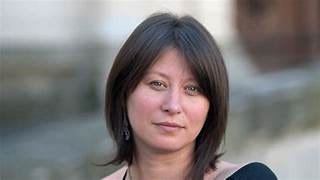
[Halyna Kruk]
On February 24th, 2022, four years ago, Russia invaded Ukraine. Although this isn’t an anniversary one can “celebrate,” we can still honor the resilience of the Ukrainian people and their rich culture. As American writers, artists, and musicians daily meet up at Starbucks sipping over-priced unpronounceable libations and narcissistically complaining about cuts to state and federal art fellowships (I’m capable of this, too), it’s important to remember that at the Paris Olympics, according to Reuters, at least 488 Ukrainian athletes and trainers had been killed since early 2022, and it’s estimated that, over the last four years, hundreds of artists from all genres have perished. I’m sure that these estimates are lower than suggested, just as I’m sure more and more brilliant minds, minds that can significantly changed the world, will perish as time goes on.
So what can we do to offset the current administration’s shameful treatment of Ukraine and their president. Go online. Contribute to Ukrainian help funds. Buy merchandise whose profits go to help everyday Ukrainians.
But, for today, let’s just read and be moved by the poetry of one of Ukrainian’s best contemporary poets, Halyna Kruk. Below is an introduction and sampling of her work.
[This introduction was co-written by Halyna’s translators Dzvinia Orlowsky and Ali Kinsella. Find Halyna’s new book, Lost in Living, at Lost in Living Her first book, A Crash Course in Molotov Cocktails, was published by Arrowsmith Press in 2023, translated by in Amelia Glaser and Yulia Ilchuk's, which was a finalist for the Griffin Prize in 2024. You can find it on Amazon at A Crash Course]
Halyna Kruk is one of Ukraine’s most compelling contemporary poets—an artist driven, as Czesław Miłosz once defined poetry itself, by a “passionate pursuit of the real.” Her poems don’t hover at a safe distance from experience; they move straight toward it, with a clarity and urgency that feels almost physical. A 2024 Griffin Poetry Prize finalist, Kruk is the award-winning author of five books of poetry as well as works of prose. She lives and works in Lviv, Ukraine.
A central voice in Ukraine’s post-Soviet literary renaissance, Kruk came of age in the vibrant, experimental literary culture of 1990s Lviv, where irreverence, formal daring, and ethical seriousness were inseparable. From her earliest books to her most recent work, she has used imagery and tonal shifts to draw readers into moments where the stakes are unmistakably human.
Lost in Living (Lost Horse Press, 2024) Lost in Living, Kruk’s first full-length collection in English—from which “we carry our dead,” “vyshyvanka,” and “heavy water” are excerpted here with permission—gathers poems written before and during Russia’s full-scale invasion of Ukraine. This is not a book about war so much as a book written in its long shadow, where death is ever-present, hope is provisional, and meaning must be made from the smallest acts of attention and care. Kruk has said that poetry cannot stop bullets, that “no metaphors work against an armed soldier.” And yet, in poems that refuse consolation without surrendering to despair, she insists on what poetry can still do: sharpen awareness, honor vulnerability, and affirm survival itself as a form of action. Included here as well is an untitled poem (“what are you afraid of, heart”), whose translation is unpublished in the United States.
we carry our dead

we carry our dead like children
lay them out in the plaza and encircle them
in the frost   the snow   bewildered
as if none of us yet knew
it was so easy to die

everyone still hopes
they will lie there and then get up

for what should we tell their moms
what to tell their children
who will tell them the worst

a person runs to meet a bullet
with a wooden shield
and a hot heart
and a head in a ski helmet
full of blood

mom, I’ve got my hat on   he shouts into a dead phone
mom, his hat is too thin   the bullet hisses

vyshyvanka day

“we recognized our men by their embroidery,”
the old woman next door told me
about those executed in forty-six

“there was nothing else left to
recognize them by—a continuous wound.
each remembered her embroidery”

may we never have to
identify our own only by their embroidery
I thought then

even if there are so many of us
I think now

heavy water

and when you don’t care
		            to whom all these poems are dedicated
and when you no longer believe
		            you can stop blood with words
and turn heavy water into wine
and all that you have enough inner light for
is to see that there no more calls, texts, wonder
what are you now supposed to do with the rest of your life?
		          (vending machines here rarely give change,
especially when the bill is crinkled,
			                 like your face after driving all night)
it’s five, daybreak is soon and the semis at the gas station sleep
				                    standing up like elephants
and you get hung up on the thought that you’ve never seen
				                    how elephant calves sleep
and this all would be so tragic if it weren’t so widespread
in the all-powerful voice of the lord
			                the cashier says, “your macchiato”
and returns you to life from your desert
where you’ve been searching all these forty years for an exit and
	here it is:
							                                  go
and your decisiveness scares the random morning shooting victims
and you calmly tell them, “don’t be afraid, I’m peaceful”
and after a pause you add, “peaceful as an atom”

This is a new poem from Halyna

			          ***

what are you afraid of, heart,—her subconscious asks—
	that you won’t be able to return home?
   there’s nothing left—only ruins and emptiness
	consider this an endless vacation

when else would you be able to live with a sea view,
	learn mindfulness, do yoga,
   isn’t this what you wanted? not this, she says

   when the wind drives a flock of clouds at dusk
   every good householder comes out to meet it
relaxed elderly people, their shoulders straightened
   their faces lit up, and children safe everywhere

like an abundant scattering of pearls, so generously ripened
	olive eyes, broad gestures, swift chatter,
what are you afraid of heart? that you’ll get used to safety?
   that you’ll fall for luxury? that you won’t hurt anymore

   for the land where there’s nothing but ashes and ruin,
so much of it that even in dreams you fear stepping there

what do you beat for, heart?—her unconscious wonders,
   this woman returning to Ukraine from paradise
								    April 2025

[co-translated by Ali Kinsella and Dzvinia Orlowsky]
You can find Peter Johnson’s books, along with interviews with him, appearances, and other information at peterjohnsonauthor.com
His most recent book of prose poems is While the Undertaker Sleeps: Collected and New Prose Poems in paperback ($24) and hardcover ($30). In the Kindle Store, it’s free on Kindle Limited, or, surprisingly, only $5 if you don’t have Kindle Limited KindleUndertaker (Publisher, MadHat Press).
His most recent book of fiction is Shot: A Novel in Stories
Find out why he is giving away his new book of prose poem/fragments, even though he has a publisher for it, by downloading the PDF from the below link or going to OLD MAN’S homepage. His “Note to the Reader” and “Introduction” at the beginning of the PDF explains it all: Observations from the Edge of the Abyss