
The Poetry of Dzvinia Orlowsky
Her New Book and Ukrainian Heritage

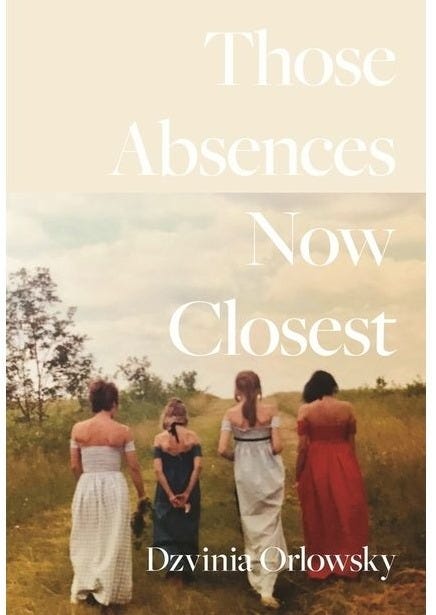
All of us poets lug certain obsessions, preoccupations, and experiences around on our backs long before we ever thought to write poetry. As adults, sometimes we celebrate them in verse; other times we manipulate the arts to convince ourselves we can flee their trauma.
In this respect, Dzvinia Orlowsky is no different than most poets, except that she transforms her obsessions, preoccupations, and experiences into a poetry that’s more memorable than most of what one might read in contemporary journals.
For the purposes of this post, I want to focus on her Ukrainian background, which tends to inform all of work. Below is a prose poem and commentary on that poem from an anthology I edited A Cast-iron Aeroplane
After that anthology piece, are three terrific verse poems from her new book, Those Absences Now Closest Those Absences
To learn more about this poet, editor, and translator, please visit her site: About Dzvinia
At the end of February, I’ll be publishing excerpts from Ukrainian poet Halyna Kruk’s book, Lost in Living, translated into English by Dzvinia and Ali Kinsella.
Let’s not get distracted from Ukraine’s plight by this administration’s daily dramas, real or imagined, by which I mean made-up.
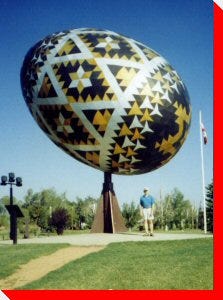
Vegreville Egg
Like a hornet caught in a jar, static buzzing between words, he yells from across Manitoba’s endless ice into the phone, two provinces away from the world’s second largest pysanka, a Ukrainian-style Easter egg. Black and gold tiled, it turns in the wind like a colossal weathervane. Holding two separate rotary phone extensions, my parents yell It’s Uncle Bohdan! interrupting each other in excited disbelief. Squatted on the floor next to my mother’s legs, I dress my naked Mary Poppins doll in spiked heels and pretend to also be happy. Mathematically mastered, steel-girdled, three and a half stories high, weighing in at 2.5 tons—we simply had to see it—a pleasant 1,181-mile drive from Ohio to Egg. We pack a picnic, boiled eggs and sardines. What did we know about roadside burgers? But more pressingly, what did we know of art? Except that our home— family and guests insisted—aside from not having a framed print of the egg—was filled with it: paintings by our own kind that one day my parents whispered to us as if revealing an important family secret would be worth a fortune—despite the fact that, it turns out, these were not master oil paintings but rather, acrylic cartoons of our people doing our-people kind of things—playing Kitchkari, Ukrainian ring toss, or dancing in red leather boots, multi-colored satin ribbons streaming from flower wreaths in women’s hair, men sporting handle-bar mustaches— paintings that showed happy people, stomping and spinning in place.
Commentary
The publication of Stephen Berg’s prose poetry collection, Shaving, in 1998 by Four Way Books provided a one-of-a-kind opportunity for me. At that time, I was in my fifth year as a founding editor, and we had the good fortune of having Berg approach us about publishing his book. Back then, some writers still preferred to type their manuscripts, and Berg, being one of those writers, was not able provide us with a floppy disk. A fast typist, I volunteered to key it in for him—51 prose poems, 107 pages.
I’d published my first prose poem in 1973 but had pretty much abandoned the form thereafter in favor of verse. The immersion in Berg’s book, getting to know it on a physical level by keying it in, re-ignited a deeper understanding and appreciation for what a prose poem can do. What I took from it, primarily, was how when compressed, different layers of thought and speculation can shape a reflective narrative into a lyrical piece that stretches from margin to margin.
With this consideration in mind, I began writing a sequence of prose poems about 10 years ago including “Vegreville Egg.” This poem was written about a particular phone conversation recalled from childhood—a few shared moments of much excitement between my parents and a close immigrant friend discussing colossal national treasures, sure-fire investments, and “best kept secrets” of contemporary Ukrainian art. Characteristically, Ukrainians love to out yell or to interrupt each other in conversation. Maybe it’s enthusiasm rather than rudeness, an inherited sense of rushing to say what you have to say before the other proverbial shoe drops and pulverizes your cultural nest egg or your mother tongue is altogether obliterated.
I wrote this as a prose poem because prose poetry, line to line, moves with greater fluidity and because it loves secrets, half-truths, and the implausible—all taken into consideration as part of one conversation. Its meandering syntactical cadences encourage a voice to travel greater distances—to spin stories, colorful and zestful— beyond demarcations, without ever leaving its frame.
And now some poems from her new book, Those Absences Now Closest.
“Newton’s Cradle”
—Fourth of July
1.
A crazy good time for everyone drinking
and blowing themselves up,
for the guns, bells, and the bonfires,
and for the flames hurled towards the tops of buildings.
But not for our dog, Petroushka,
swaddled in an old nightgown, shaking.
Not for my mother anxiously rocking her,
pillows propping her up in bed.
Not for silence
beating with an animal heart, the synchronized
clockwork held within a small rib cage,
short-haired fur—as soft, she used to say,
as a velvet glove lost behind
an opera house seat
or dropped in the snow searching for a key.
A luxury one couldn’t count on.
2.
Not for the sky backfiring into showering
white spiders, the dog’s pupils
darkening into small black umbrellas.
Not for bad luck getting personal in July 1942.
Not for the unwanted child aborted on a kitchen table.
Who would take care of it—
An unborn brother
or sister blocking Mother’s ears
with ghostly small fingers.
Not for birds that lie scattered lifeless on the ground
or for the disoriented bees that won’t go back to their hives.
Stars & Stripes Forever rushing to its end.
3.
Not for her waving me away: Leave me alone.
Or calling me back: Stay if you understand.
I wish I’d stayed. I kissed
the top of her head and left.
Some skies are impermeable to fire.
Some fires die as red skies.
Like silver slingshot balls, the collisions
would resound forever.
”War”
How many deaths must it take to be considered a war?
—1,000 lives, Google
But the first 100 are only fooling.
They’ve saved their caboodles from drama class.
Death makeup is a breeze.
They clear their throats, step into the spotlight, center stage.
A mother applauds.
Outside, moonlight carves its solid world.
* * *
The second 100 are children again.
They run through fields of daisies,
fingers interlocked, index fingers pointing.
Ra-ta-tat-tat!
We’re safe!
Migrative imagination,
pretend machine guns
execute a pact.
* * *
The third 100 drag their feet, lost,
heavy with song.
Song is healthy for the soul.
But who will listen?
Fearful neighbors
slam their doors shut.
Surely you understand, they whisper.
* * *
The fourth 100 never vacate their apartments.
They’re still there
lying quiet in their beds,
their bodies packed with prayers.
A concrete city block disintegrates
between earth and air.
* * *
The fifth 100 simply refuse to die
until they find their daughters’
favorite stuffed bear,
the one with the black-button, blind eyes
that keeps her safe at night.
* * *
The sixth 100 press their ears to a hollow wall.
Who is shouting in the dark?
Not everyone who hears voices is unwell.
* * *
A plastic View-Master, a last luxury to be held
in their son’s hands,
the seventh 100 cry a creek—a stream—a river
* * *
The eighth 100
don’t remember first words,
don’t hear last screams—
their mouths open like that of a toddler
gasping for air.
* * *
A living heart!
Here!
The ninth 100 believe they are still
warm inside,
the way a burning forest believes
it’s a perfect metaphor for the spiritual world
even after it’s ash.
* * *
999
. . . are missing one
who got away.
Praise be!
”If we weren’t knocking on wood”
or spitting our way to safety, we
were always busy looking for signs
from our deceased loved ones
who still cared enough to visit.
A branch hanging crooked meant
a missed connection. We developed
a mystical lexicon for our secret beliefs.
“Unfounded” implied: A stronger signal
from the afterlife is yet to come.
“Groundless” confirmed: Look to the sky.
The dead always had our best interest
in mind. All we had to do was ask.
My mother died on August 30, the same
as my father, surviving him by 29 years.
One night, recognizing her imminent death,
my sister and I prayed to him to come
and escort her into the next world.
My father was a resilient, good-natured man.
And he played the guitar. Maybe my mother
remembered his body as song.
He would settle in outside her window
and chirp, wings raised and rubbing. But
I never understood why a frog; there was
something in that appropriation—
imagining his eager thumping forward
in the grass—that made him seem
excessively soft and vulnerable.
I don’t know how he appeared to her
the night she died. Or what transported
him to her bedside. Most likely, it wasn’t
a Carriage—or something fragile as a cricket—
more likely a bird, or just a feather.
We looked around on the floor
and found nothing. But we knew
his heart was in it—by the way
the phone rang three times then stopped.
You can find Peter Johnson’s books, along with interviews with him, appearances, and other information at peterjohnsonauthor.com
His most recent book of prose poems is While the Undertaker Sleeps: Collected and New Prose Poems
His most recent book of fiction is Shot: A Novel in Stories
Find out why he is giving away his new book of prose poem/fragments, even though he has a publisher for it, by downloading the PDF from the below link or going to OLD MAN’S homepage. His “Note to the Reader” and “Introduction” at the beginning of the PDF explains it all: Observations from the Edge of the Abyss