
Republic Steel, Proust, and the Acts of the Apostles
With a Reflection on the Existential Question Mark

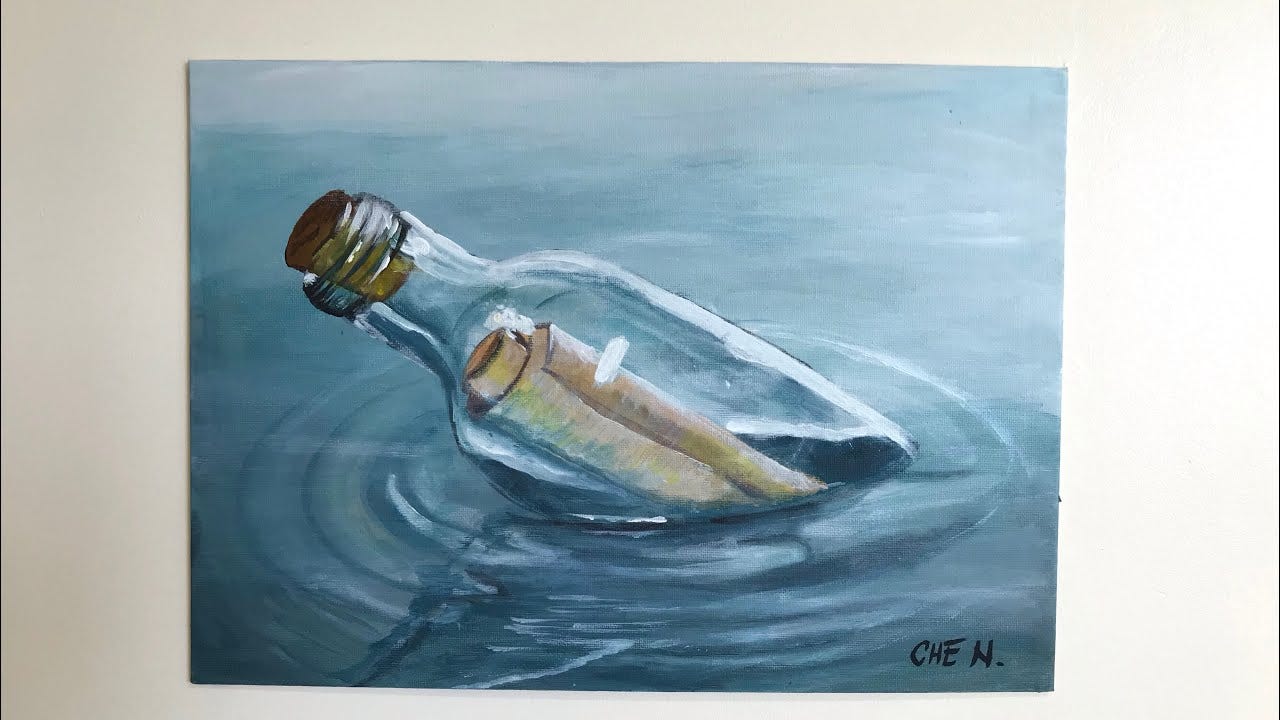
As of late I have become excited about focusing exclusively on the “dispatch” as a genre. Certainly, other authors’ short prose has been juxtaposed in books, and yet I feel this is a new genre of sorts—one that is especially suitable for Substack. Think of my “dispatches” as hybrid notes in a bottle sent by an aging humanist stuck on an island of uncertainty, as he tries to make sense of a world where the grand narratives he has lived by and satirized are fading faster than an aging action hero’s career.
You can find this new dispatch in Danny Lawless’ PLUME poetry journal that dropped yesterday. NewDispatchinPlume
Please share this link and make others aware of PLUME, a monthly literary journal you can get for free. Every month, you will have the opportunity to read fine poetry, essays, interviews, and reviews.
Below, as a tease, is he opening to my new dispatch. The whole dispatch, again, is at NewDispatchinPlume
“Republic Steel, Proust, and the Acts of the Apostles, with a Reflection on the Question Mark: A Study in Literary Influence”
The images selected by memory are as arbitrary, as narrow, as elusive as those which the imagination had formed and reality has destroyed. There is no reason why, existing outside ourselves, a real place should conform to the pictures in our memory rather than those in our dreams.—Marcel Proust
“Bedtime Story”
When I was twelve, a horse appeared. It carried King Richard disguised as a policeman. All night long my street glimmered. Car doors opened and closed. The owner of the steel plant wanted to know the secret, wanted to stroke my mother’s perfect breasts. The secret was to be in the presence of a horse or surrounded by red and green flowers that never grew in my neighborhood. There were dandelions. And tulips coated with metallic flakes. In the suburbs, privileged armies faced off, displaying their silken banners. I could hear the clash of armor when I closed my eyes.
***
Reasons I Should Be Dead
The fine layer of ore dust my mother would wipe off our Formica dinner table on warm summer afternoons.
The hour after work when I’d purge dust from my nasal passages by snuffling tap water through my nostrils, then snorting it out.
The two packs of Camel non-filters I chain-smoked for eight years.
The swirling sheetrock dust when I was a drywall subcontractor as a diesel torpedo heater’s giant red eye expelled its poison into the air.
My part-time job in a Formica factory, where I’d lather kitchen counter forms with glue, mold sheets of Formica to them, then trim them with a router.
The 1990 New York State Cancer Registry’s report that the zip code including my steel plant job and neighborhood had “51 percent more instances of lung cancer than expected among men, and 42 percent more instances than expected among women.”
So why should I be surprised that my lungs bear the scars of pleurisy I contracted three times from the ages of fourteen to twenty?
Why so shocked that I have COPD?
Why so astonished when I was diagnosed with Chronic Lymphocytic Leukemia two years ago?
***
In Remembrance of Things Past, Marcel Proust describes an epiphany that would eventually release a flood of memories responsible for his masterpiece. As he explains, he returns home one day in winter where his mother, recognizing he appears chilled, offers him some tea. “She sent out for one of those short, plump little cakes called ‘petites madeleines,’” he writes, “which look as though they had been molded in the fluted scallop of a pilgrim’s shell. And soon, mechanically, weary after a dull day with the prospect of a depressing morrow, I raised to my lips a spoonful of the tea in which I had soaked a morsel of the cake. No sooner had the warm liquid, and the crumbs with it, touched my palate, a shudder ran through my whole body, and I stopped, intent upon the extraordinary changes that were taking place. An exquisite pleasure had invaded my senses, but individual, detached, with no suggestion of its origin. And at once the vicissitudes of life had become indifferent to me, its disasters innocuous, its brevity illusory—this new sensation having had on me the effect which love has of filling me with a precious essence; or rather this essence was not in me, it was myself. I had ceased now to feel mediocre, accidental, mortal.”
Proust can have his spoonful of tea and madeleine cookie crumbs, but, for me, the smell and taste of my illiterate Polish grandmother’s hot-buttered rolls send me back to my youth. Sometimes I’d crash at her house after the late shift, and, in the morning, she’d slice and butter a few of her rolls, then Saran Wrap and pack them in my lunch box, sparing me from the stale food truck’s baked goods that were as tasteless my mother’s Hamburger Helper Swedish Meatball dinner. I can still see my grandmother (to the outside world, a stern-faced old battleaxe), leaning over an open stove, lovingly basting her rolls every five minutes. It’s an image that often appears in my work, an objective correlative for the collision between the cuisine of the Old Country and the realities of an industrial modern world. Studies of famous poets often discuss the author’s use of irony or ambiguity, but if I were writing a book on Peter Johnson’s work, I’d focus on the juxtaposition of the high and low—the cover of that book being an image of a huge roll dripping with butter, resting peacefully in the ore-stained hand of a steelworker.
***
[Yet again, you can the rest of this dispatch at NewDispatchinPlume
You can find Peter Johnson’s books, along with interviews with him, appearances, and other information at peterjohnsonauthor.com
His most recent book of prose poems is While the Undertaker Sleeps: Collected and New Prose Poems in paperback ($24) and hardcover ($30). In the Kindle Store, it’s free on Kindle Limited, or, surprisingly, only $5 if you don’t have Kindle Limited KindleUndertaker (Publisher, MadHat Press).
His most recent book of fiction is Shot: A Novel in Stories
Find out why he is giving away his new book of prose poem/fragments, even though he has a publisher for it, by downloading the PDF from the below link or going to OLD MAN’S homepage. His “Note to the Reader” and “Introduction” at the beginning of the PDF explains it all: Observations from the Edge of the Abyss